About Us
What is a district?
Under NC General Statute 139, soil and water conservation districts are organized as governmental subdivisions of the state, as well as independent political units. Districts work closely with county, state and federal governments and both public and private organizations in a non-regulatory capacity to carry out a comprehensive conservation program that protects and improves the county's natural resources while assisting private landowners in using conservation practices. This partnership has been the backbone of highly successful efforts over the past 75 years to address serious problems across the state including soil erosion, flood damage and water quality problems.
the History of Durham Soil and Water Conservation District
During the devastation of the early 1900’s dust bowl, the “Father of Soil Conservation” Dr. Hugh Hammond Bennett established ten erosion stations that generated more than 300,000 quantitative measurements of soil and water losses. The results of these studies led to the creation of the Soil Erosion Service of the Department of Interior in September 1933. Due to a large outcry for national policy on soil erosion control, U.S. Public Law 46 was passed in 1935. This policy established a federal agency known as the Soil Conservation Service. As a way of delivering the technical assistance to local landowners, the Soil and Water Conservation Districts were formed when President Roosevelt sent a letter to the nation’s governors urging them to adopt the Standard State District law. Each state responded and passed such legislation. That same year North Carolina General Assembly passed Chapter 139 of the North Carolina General Statutes which allowed for Soil and Water Conservation Districts to be formed.
The Durham Soil and Water Conservation District was first established on March 22, 1939 as part of the Upper Neuse River Soil Conservation District. Districts back then were established by watershed boundaries and the Upper Neuse covered five counties Durham, Granville, Orange, Person and Wake. On February 2, 1965 the Durham District became an independent district. The visibility of the Districts was further raised in 1973 when the Soil and Water District Boards moved from a then called “shoe box elections” held at country stores to the general election. As a result, beginning in 1974, District Board members were elected at the same time as other county officials.
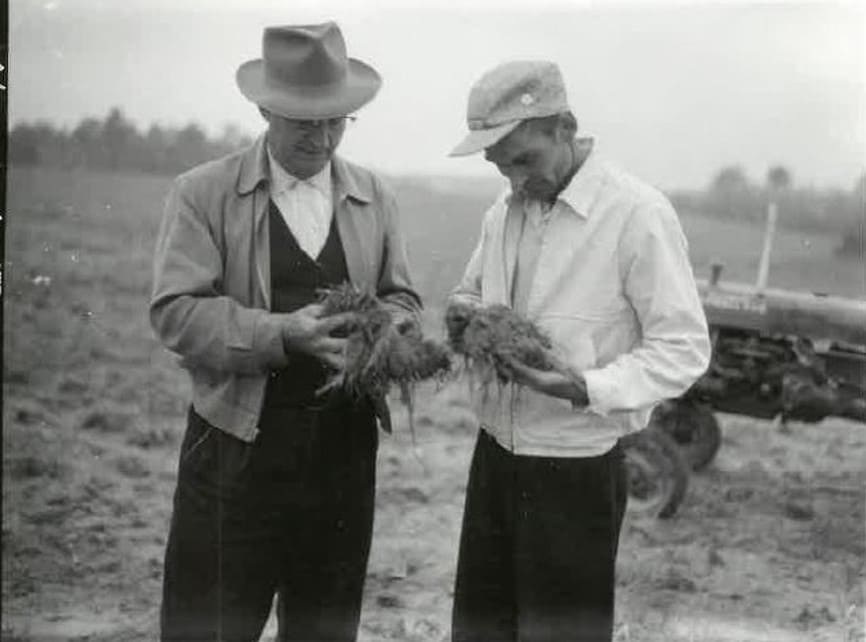
From the conception of the Durham Soil and Water Conservation District until the mid 1980’s the main focus of the District was providing technical assistance to the agriculture community. Numerous Best Management Practices (BMP’s) were installed mainly in the Little River and Lake Michie watersheds. As a result of these efforts both reservoirs provide drinking water to Durham residents that are not impaired from a state standard point of view. On the other hand, with the arrival of Research Triangle Park (RTP) and the increase in urbanization, the District began to notice new environmental problems on the horizon. Sediment deposits into the watercourses from urbanization, atmospheric deposition, rise in downtown temperature, litter as a result of humans all have contributed to negative effects downstream. By the late 80’s the District began to see the need for diversifying its programs.
Today the District has diversified its programs to meet the changing needs of the county. This diversification has gained the District and its employee’s recognition through various awards in recent years. One way is through the implementation of stream restoration and stormwater projects in the county. These grant funded projects have helped reduce the impact that urbanization has caused throughout the years. Additionally, work has risen with private homeowners and business entities as BMP’s such as rain gardens, cisterns, etc. are now offered to all with water quality issues. The District has achieved a greater reduction of nutrients entering the reservoirs through the creation of its “Voluntary Nutrient Reduction Program”. The District plays a vital role on behalf of the residents of Durham with their involvement in both the Jordan and Falls Watershed rules. The coordination of “Big Sweep” litter cleanups has made an impact on the aesthetics of the county. Finally, the District’s environmental education program has expanded and is reaching numerous residents to educate them in hope that they realize how important our natural resources are and what effect we as humans are having on them.