




City and County Announce Recommendations from “Summit on Saving Lives” to Reduce Violence in Durham
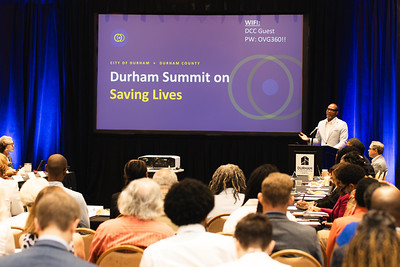
DURHAM, N.C. – Following the three-day Summit on Saving Lives held in June, the City of Durham and Durham County today announced the final working group recommendations which mark a renewed, joint commitment to reducing gun violence through coordinated, evidence-informed action. The recommendations establish a clear mission for local violence reduction: reducing homicides, nonfatal shootings, and hospitalizations due to shootings by 10% each year.
The release of these recommendations follows a six-month collaborative effort to analyze local data and gather community input. During the summit, working group members—including residents with lived experience, local faith and civic leaders, law enforcement officials, and national experts—reviewed findings from a comprehensive Gun Violence Problem Analysis (GVPA) conducted by the University of Pennsylvania Crime and Justice Policy Lab, as well as insights from more than 15 community listening sessions reaching hundreds of residents across Durham.
The analysis revealed that homicides in Durham are overwhelmingly firearm-related (90%) and dispute driven (66%), and that more than half of these homicides involve a small number of groups, roughly 430–685 people, just 0.2% of the city’s population. Further, data showed that adults aged 18 to 34 drive the majority of serious violence in the community. Across the listening sessions, residents emphasized that while Durham is resource-rich, local programs have historically lacked central coordination.
“Our commitment to reducing gun violence in the Bull City requires total collaboration across local governments, organizations already doing this critical work, and our residents. These recommendations provide a practical blueprint that balances targeted support with accountability to ensure our resources reach the people and places at highest risk,” said Mayor Leonardo Williams. “With the partnership of the County, we are taking decisive action to keep our neighbors alive, safe, and filled with hope.”
Durham County Commission Chair Dr. Mike Lee said, “Durham’s Working Group on Violence Reduction has provided a clear, evidence‑based path forward, and we are grateful for the leadership, community voices, and expertise that shaped these recommendations. The call for more focus, better coordination, and deeper partnership reflects exactly what we have heard from residents across our county. We are committed to advancing strategies that meet people where they are, supporting those at highest risk, investing in the neighborhoods most impacted, and ensuring that every action we take is grounded in fairness, transparency, and accountability.”
"Community violence is a complex issue, but it is not an unsolvable one. The recommendations from the Durham Saves Lives Summit provide a thoughtful and strategic roadmap that can only succeed through sustained collaboration, shared accountability, and collective action. As someone who witnesses the impact of violence on individuals, families, and communities on a daily basis, I believe we cannot afford to wait, nor can we afford to work in silos," said member of the working group Uzuri Holder, LCSW, VPP, program manager of the Violence Recovery Program at Duke University Hospital.
"Saving lives in Durham requires more than programs; it requires a coordinated community committed to partnership, consistency, accountability and action. I support these recommendations because they provide a strong foundation for reducing violence today while creating opportunities to strengthen neighborhood-based, family-centered solutions that will help prevent violence in Durham for generations to come," said member of the working group Tiffany Swoope, founder and executive director of Greater Ascencion Community and Economic Development, Inc. (GRACED, Inc.)
Working group members unanimously agreed on five key strategies to reduce violence:
- Focus Support and Accountability: Implement a focused deterrence initiative to engage the highest-risk individuals and groups with a combination of supports and accountability.
- Strengthen Street Outreach: Re-invest in community-based street outreach, but with strong safeguards to ensure proper management and oversight.
- Pilot Neighborhood Partnerships: Pilot place-based partnerships in the highest-risk areas where violence concentrates to improve the physical and social environment of these locations, involving a diverse array of stakeholders, including residents; community, faith, and civic partners; governmental agencies; and law enforcement.
- Embed Trauma-Informed Behavior Change: Overlay trauma-informed cognitive behavioral techniques across all the above strategies, training residents, service providers, outreach workers, and law enforcement in how to promote healing as well as thinking and behavior change.
- Convene a Youth Summit: Hold a separate Youth Summit on Saving Lives to explore the specific challenges facing children and adolescents in Durham and develop concrete recommendations for action.
To ensure transparent execution and governance, the working group also recommended that the City and County establish key oversight structures, including creating two dedicated full-time staff positions and forming a multidisciplinary advisory board chaired by local leadership and open to the public.
The full report is available on the City’s webpage.
Next steps include presentations to the City Council at their August 20 Work Session and to the Board of Commissioners at their September 8 Work Session. The City Council Work Session will be broadcast on Durham Television Network and livestreamed on the City’s Facebook and YouTube channels, and on the City’s website. Residents can join the Board of Commissioner’s Work Session in-person or via zoom by visiting the County’s website.